A different way to create the B2B relationships you most want
Does Improved Engagement Start By Not Sending a Sales Approach?
They’ve never been easier to find.
Never been easier to research.
Never been easier to approach.
So why is getting them to engage the real problem?
AI is accelerating a paradox that started with the internet and multiplied with automation.
More people. More messages. More apparent personalisation.
But as the technology has become better at reaching people, busy B2B decision-makers have become better at avoiding being sold to.
They have had to. For their sanity and to protect their time.
Faced with an ever-increasing volume of sales approaches, they’ve become increasingly effective at recognising and avoiding them.
Instantly.
To the point where the defence mechanism can kick in before they’ve even read the subject line.
It's become an inbuilt avoidance reflex.
Sales approaches are mentally and automatically classified as something to avoid before your proposition has even been considered.
And once you’re automatically relegated to this zone there’s an even bigger problem.
Because you’ve mentally become earmarked as someone with something to avoid.
Then it becomes almost impossible to message, market or sell your way out of it.
But what if we could change that?
What if more of the prospects you really want to win actually WANTED to engage?
It takes a completely different approach.
That’s what we’ve developed.
The AI Paradox and The Solution We're Being Led to Believe…
AI is becoming remarkably good at identifying the right prospects, researching them and creating highly personalised approaches.
And there are real advantages.
LinkedIn’s own research reports significant improvements in response rates from AI-assisted personalised outreach.
But they’re still sales approaches landing in a sea of sales resistance, triggering the avoidance reflex we’ve just described.
So while the technology becomes increasingly sophisticated at creating the approach, the people receiving it are becoming increasingly motivated and sophisticated at recognising and avoiding it.
We’re getting better at the very thing they’re getting better at avoiding.
That’s the paradox.
Even when AI can communicate convincingly in your voice, with your positioning and your brand, there’s still a fundamental problem.
It’s trying to sell before the prospect is ready to be sold to.
So perhaps we’re asking AI to solve the wrong problem.
Do we use AI simply to become better at doing what everybody else is doing?
Or could we use it to make a completely different approach possible?
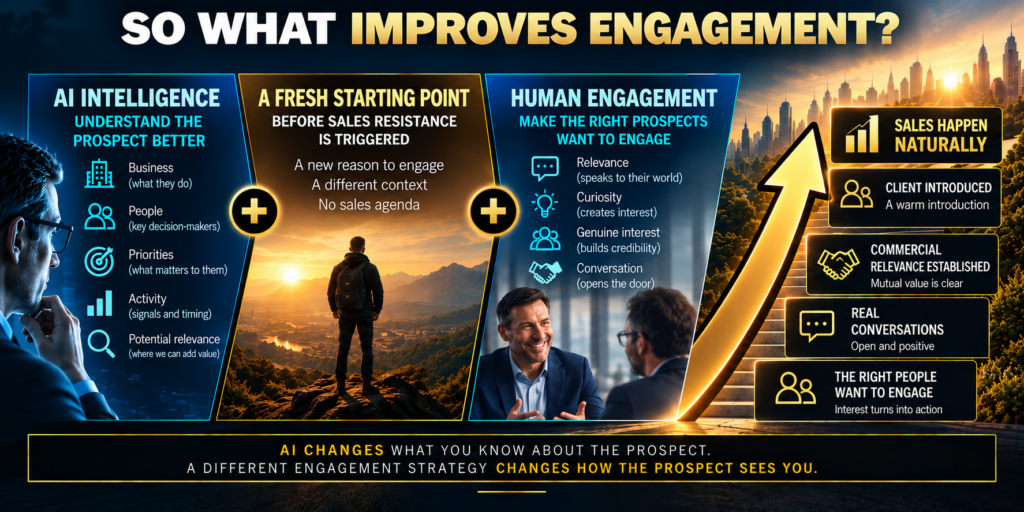
What if we used AI to understand, engage and build relationships with the right prospects, rather than simply sell to more of them?
AI can do the heavy lifting.
Research the business. Understand the market. Identify the right people. Discover what’s happening around them. Establish whether there might be a genuine reason for a conversation.
At a depth and scale that would previously have been impractical.
Then the AI stops.
Because the next challenge isn’t technological.
It’s human.
How do you turn all that intelligence into a conversation somebody actually wants to have?
That’s where we come in.

Before Any Sales Approach, What if There Was Already a Reason to Talk?
What if the first objective wasn't to sell anything?
The moment a valuable prospect believes they’re being approached by somebody who wants to sell to them, all those defence mechanisms we’ve described can lead to automatic avoidance.
And if your company has approached them before and already been mentally placed in the “to be avoided” category, it’s even more difficult to get them to engage differently next time.
So we change the starting point.
We don’t begin with your proposition, your brand or your story.
We begin with your prospect.
Using the intelligence already gathered, we look for a genuine commercial reason to engage them.
Something relevant to their business, their market, their role or what’s happening around them.
But importantly, one of our people starts the engagement.
Not you. Not your sales team. Not your brand.
Not to disguise a sales message.
But to start a conversation worth having.
We listen. We respond. We use judgement.
And importantly, we don’t force your business into the conversation before there’s a reason for it to be there.
If genuine relevance and interest develop, something important changes.
Your business doesn’t need to arrive as another sales approach. It can be introduced as part of a conversation the prospect already wants to have.
The relationship starts before the selling does.
Instead of trying to overcome sales resistance and automatic avoidance, you enter a conversation with someone who already has a reason to WANT it to happen.
Start with the companies you ideally want to win
Not 100 leads selected because they match some basic criteria.
Not 100 names added to an automated sequence.
The 100 companies you would genuinely choose if you could.
Some may know you already.
Some may have ignored previous approaches.
Some may be relationships you’ve never managed to start.
Some you may even have lost to competitors.
Others may simply have been too difficult or time-consuming to approach with the individual attention they deserved.
Until now, researching and approaching every one of those companies properly would have required an enormous amount of human time.
And even then, you still faced the same problem:
How do you approach them without triggering the avoidance reflex before your proposition has even been considered?
AI changes the economics of that.
It allows us to do much of the research, intelligence gathering and preparation at a scale that wasn’t previously practical.
But instead of using that advantage to send “better” and more sales messages in the hope of getting through the automatic avoidance reflex…
We use it to give a relatively small number of valuable prospects far more individual attention.
And then people take over.
That scales the work that creates the relationship. Not the pressure trying to force it.

Ask yourself: how and why are you here?
Because you’re now engaging with us and reading this, you’ve already experienced part of how we work.
We selected you.
We researched your business, your market and your role.
We considered whether there was a genuine commercial reason for us to approach you.
But we didn’t start by telling you about KRO, our services or what we wanted to sell.
We started with something we thought might be worth a conversation.
A real person then engaged with you as an individual. Human to human.
And something in that process gave you enough reason to engage and find out more.
And it’s the perfect way of explaining what KRO does. You are your own case study.
That’s the difference.
And the key is your best prospects can be positioned in exactly the same way.
What happens next?
Now imagine engaging this way with the companies you most want to win.
You choose the businesses where a new relationship could have significant commercial value.
Then we build the process around them.
Not a sales message.
And importantly, the initial engagement happens outside your existing sales channels.
It doesn’t begin with your brand, your proposition or another message from somebody trying to sell your services.
We create a willingness to engage first.
Without leading or emphasising a sales agenda.
That gives the conversation room to develop before your prospect has a reason to trigger their automatic avoidance reflex.
It also means we’re not repeatedly exposing your brand to prospects who may already have ignored, avoided or rejected previous approaches.
Your business only enters the conversation when there’s authentic reason.
1. SELECT
The companies and decision-makers you particularly want to reach.
2. UNDERSTAND
AI-assisted research does the heavy lifting, building the intelligence needed to understand each business, person and potential reason for engagement.
3. THINK
We apply human commercial judgement to that intelligence.
Why this person? Why now? What’s worth talking about?
4. ENGAGE
A real person makes the initial approach, individually and with a reason for starting the conversation.
5. CONVERSE
When they respond, a human continues the conversation.
We listen. We respond. We use judgement. We establish whether genuine relevance and commercial potential exist.
6. INTRODUCE
When there’s a genuine commercial reason for your business to enter the conversation, we make the introduction.
Your brand arrives with relevance and strength, instead of having to fight for acceptance in a sea of sales resistance.
Research first. Relevance second. Conversation third. Introduction fourth. Selling comes later. But only as a solution to a problem it is agreed exists.
You don't need 100 new customers for this to matter.
This is different because it focuses on the companies you genuinely WANT to work with.
What is one new customer from that group worth to your business?
Not simply the first piece of work.
The value of the relationship.
For some businesses that might be £10,000.
For others £50,000, £100,000 or considerably more.
And some of those relationships could continue producing opportunities for years.
That’s why we’re deliberately not interested in maximising the number of people approached.
The economics are completely different when you start with the companies most valuable to you.
Especially with the overriding focus of engagement before selling.
When better research, greater relevance and a different way of beginning the relationship create even a small number of conversations that otherwise wouldn’t have happened, the commercial value is substantial.
And unlike conventional ‘forced’ lead generation, success doesn’t need, expect or require hundreds of responses.
It requires the right conversations with the right people in the right companies.
In other words, fewer, but more meaningful relationships are forged that then LET sales happen naturally.
We build the capability around the relationships that matter to you.
Every business is different.
Your ideal companies are different. Their value to you is different. The people you need to reach are different. And the reasons they might want to engage with you will be different.
So this isn’t an off-the-shelf prospecting campaign.
We work with you to identify the companies you most want to win, understand what has already happened with them and identify the people who matter.
Then we build the research, intelligence, engagement and conversation process around your market, your commercial objectives and the relationships you want to create.
The initial investment is £6,000 + VAT
And there’s a reason we’re comfortable putting that number here.
Before we approached you, one of the things we considered was the potential commercial value of a new customer to your business.
We deliberately focus on businesses where a relatively small number of the right new relationships can create significant commercial value.
In your case, a single successful new customer could be worth significantly more than the entire initial investment.
That’s important, because this isn’t a model that needs dozens of new customers before the economics begin to make sense.
One valuable new relationship can change the economics completely.
And that £6,000 isn’t a fee for sending messages or buying leads.
It’s the investment required to build and launch the very different capability we’ve just described.
We develop the target-account strategy and research architecture. We map the companies and decision-makers. We research the people and businesses individually. We develop the engagement strategy, build the systems and processes behind it, and put the human capability in place to turn that intelligence into real conversations.
Then we launch it against the companies that matter.
But our commercial model is different too.
We don’t believe our long-term profits should depend on collecting a monthly agency fee regardless of the commercial results we help create.
So the £6,000 isn’t the beginning of an open-ended monthly agency commitment.
It’s the initial investment required to build and launch the capability.
After that, we prefer to agree a performance structure based on the commercial value we subsequently help create.
Because we want our profits to come from the same place as yours: successful new business.
If the relationships we originate turn into customers and commercial value for you, we participate in that success.
And if exceptional performance creates exceptional value, our commercial structure can reward that too.
That means our ongoing commercial interests are directly aligned with yours.
We’re not trying to build a relationship where our success is measured by how many months you continue paying us.
We want it measured by how much valuable new business we create together.
You fund the build. We earn our long-term profits by helping it produce yours.
So, who would your 100 be?
Before either of us decides to proceed, there are some things we need to establish.
Can you identify the companies you would genuinely choose to build relationships with over the next 12 months?
Not necessarily exactly 100.
But a meaningful group of businesses where creating the right relationships could have significant commercial value.
Because we’re making a decision too.
We need to establish:
Are the right companies identifiable?
Can we find the right people within them?
Can we see genuine reasons why they might want to engage?
Is the potential commercial value significant enough to justify the initial investment for you and the long-term opportunity for us?
And there’s one other qualification that’s equally important.
Do we actually want to work together?
We’re not looking for clients simply because they’re prepared to pay us £6,000.
That's not enough.
We want to work with businesses where we believe the commercial opportunity is genuinely significant for both of us.
But the numbers alone aren’t enough either.
The relationship has to be right.
This approach is built around relationships, judgement and trust.
That has to apply to the relationship between us too.
We want to work with good people who value what each party brings, respect each other’s expertise and can build a successful commercial relationship together.
Because we're not looking for the greatest number of clients. We're looking for the right ones.
So this isn’t simply about whether you choose KRO.
We're choosing who we want to work with too.
If the commercial opportunity is there and we believe we’re a good fit for each other, then we can decide whether it makes sense to proceed.
And there is another reason timing matters.
This isn’t a model we can scale simply by switching on more automation.
The engagement is deliberately human.
And that means there are only two ways we can grow.
We can create more commercial value for the clients we’re already working with.
Or we can take on more clients.
Both eventually require us to increase our team before we increase our capacity.
So there will be points when we deliberately stop taking on new clients while we expand the people and capability behind the service.
Right now, we have capacity.
That doesn’t mean we’re looking to fill it with anyone prepared to pay us.
Everything we’ve said about fit, commercial potential and whether we want to work together still applies.
But if those things are right, there is little advantage to waiting.
The companies you most want to win aren’t standing still either.
Relationships are forming. Conversations are happening. Opportunities are developing.
And the whole advantage of this approach is to build those relationships before everybody has a reason to start selling.
If the opportunity is there, the best time to begin creating those relationships is before you need them.
Let's start with your 100.
The first conversation is simply to establish whether the commercial opportunity and fit are strong enough for both of us to take it further.